

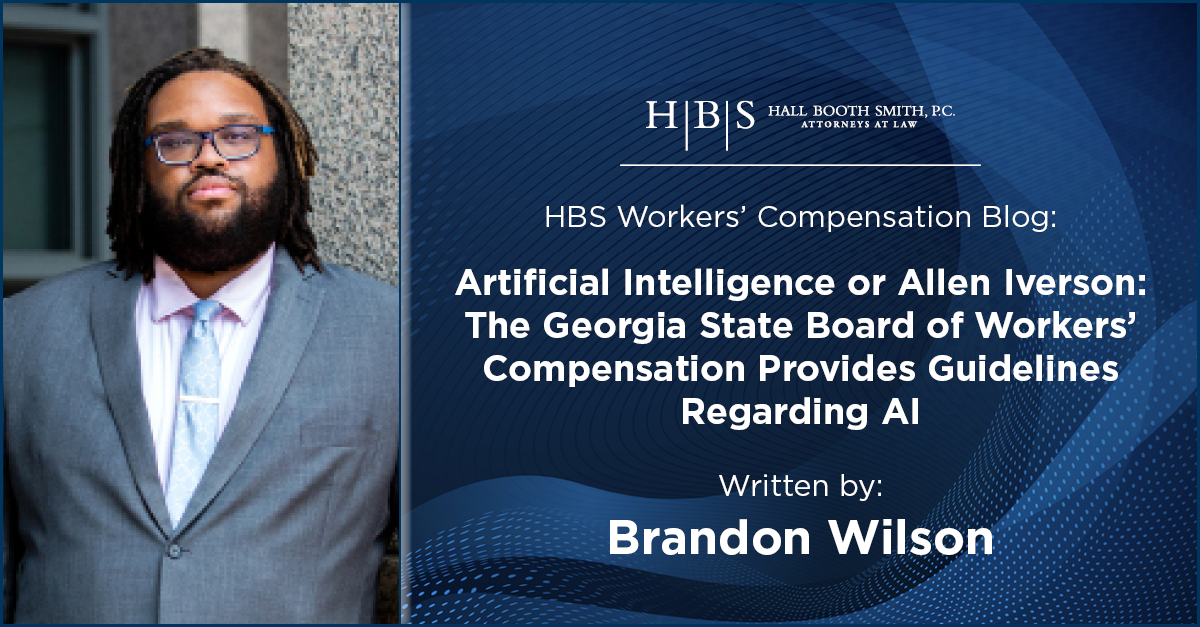
Artificial Intelligence or Allen Iverson: The Georgia State Board of Workers’ Compensation Provides Guidelines Regarding AI
Introduction:
Depending on who you ask, artificial intelligence (“AI”) will either be the revolutionary technological advancement that will launch us into a utopia, or societies’ ultimate undoing. Regardless of which side one tends to fall on, whether for personal or professional uses, everyone tends to agree that AI is here to stay. As such, the Georgia State Board of Workers’ Compensation (“Board”), on August 26, 2026, authored a Standing Order (“Order”) titled “Directive of the Board regarding use of Artificial Intelligence and Certification of Citations in Filings.”
The stated purpose of this Order is to govern AI in the preparation of briefs, motions, and other written submissions any person files with the Board. Notably, the Board makes it known that this is not a ban on AI but guidelines to provide transparency and accountability in using AI. The Board defines the use of AI to include “relying on any generative artificial intelligence tool, whether for drafting, summarizing, editing, verifying, or analyzing legal or factual content in a filing.” The definition does not apply to standard spell check and grammar tools embedded into word processors. The Order went into effect immediately on August 26, 2026.
Order Provisions
Certification Requirements for Attorneys and Unrepresented Parties
As referenced above, AI is here for the long haul. As such, the Board did not outlaw the use of AI in documents submitted to the Board but provided guidelines for these submissions. Notably, these guidelines extend to attorneys and unrepresented parties. Essentially, the Board creates disclosure requirements for all documents submitted to them.
If an attorney or unrepresented party uses AI to draft, edit, review or check contents of a filing, then the following certification must be included:
This document was prepared with the assistance of one or more AI tools. I certify under penalty of perjury that, despite reliance on an AI tool, I have independently reviewed the entire document to confirm accuracy, use of relevant and applicable law, and assertion of relevant and applicable legal theories.
I further certify under penalty of perjury that every citation to law, case, statute, rule, or the record in this document has been verified by me and is accurate and exists as cited and is reasonably believed by me to stand for the proposition cited.
If an attorney or unrepresented party does not use an AI tool in their filing, they must include the following statement: I certify under penalty of perjury that no part of this document was prepared using any AI tools or platforms.
AI-Generated Evidence
Furthermore, the Order contemplates AI-generated evidence. The Board notes that evidence created or modified by AI must be disclosed at the time of the evidence’s submission. Again, the rules extend to attorneys and unrepresented parties. Similar to the provisions above, this section is broken down into two categories: acknowledged AI-generated evidence and unacknowledged AI-generated evidence.
Acknowledged AI-generated evidence is openly disclosed that AI was used in the creation or modification of the evidence. The Board gives examples of reconstruction videos and expert analysis tools. Acknowledged AI-generated evidence is permissible. Conversely, unacknowledged AI-generated evidence is evidence that is presented as AI-free when it in fact has some connection to AI. The Board gives examples of deepfake videos, fabricated receipts, and manipulated photos. This form of evidence is prohibited.
As a small aside, the Board notes that arguments in filings that are supported by case citations that do not exist and/or cannot reasonably be interpreted to stand for the proposed cite violate this Order.
Enforcement
Perhaps the most interesting parts of this Order are the enforcement provisions. Violations of this Order may result in civil penalties in the amount of $100.00 to $1,000.00 per violation. Furthermore, the use of unacknowledged AI-generated evidence could result in civil penalties and/or referral to the Criminal Investigation Division of the Board. Furthermore, the Board accounts for possible excuses by noting that mistake, lack of expertise, and time constraints will not be accepted as good faith excuses for violations of the Order.
Practical Implications
In the grand scheme of things, this Order means that legal staff (attorneys, paralegals, legal secretaries, etc.) need to be careful when using AI. When submitting documents and evidence to the Board, parties will now have to certify and disclose if they used an AI tool in drafting and/or creation of any document or evidence.
The evidence submission element will likely be the least difficult directive to follow. The Board noted the distinction between acknowledged versus unacknowledged, but my interpretation is straightforward: Don’t use AI to submit fake evidence. What I anticipate may cause legal staff to “hem and haw” is the implications the Order has on research. Gone are the days when someone could pull up an AI summary regarding an issue and cite the cases in the summary without reading them. Boo-hoo. Ultimately, the Order ensures that we aren’t blithely citing cases but reading them; something we should be doing anyway.
What’s Next?
Before concluding with what could happen next, I am interested in the “why” question. Was this a proactive or reactive move by the Board? A proactive move would mean that the Board saw the possible implications of AI in researching, drafting, and writing, and decided to address the issue before it became a problem. A reactive response means that a fair amount of evidence and document submissions have been created using AI tools that have raised issues as to legitimacy and accuracy of the filings. I’d be interested to know, within the next year, the number of violations of this Order and the ultimate punishment for violators. Furthermore, will this Order stop people from using AI tools or encourage them to use them more appropriately? Only time will tell.
Click here to view Standing Order
** I certify that this post was written without the use of AI tools.
Disclaimer
This material is provided for informational purposes only. It is not intended to constitute legal advice nor does it create a client-lawyer relationship between Hall Booth Smith, P.C. and any recipient. Recipients should consult with counsel before taking any actions based on the information contained within this material. This material may be considered attorney advertising in some jurisdictions. Prior results do not guarantee a similar outcome.
Blog Overview
About the Author

Brandon Hornsby Wilson
Attorney at Law | Atlanta
T: 404.586.6628
E: bwilson@hallboothsmith.com
Brandon H. Wilson is an associate attorney in the Atlanta office of Hall Booth Smith, where he focuses his practice on workers’ compensation matters. He brings a strong litigation and investigative background to his work, having previously served as an assistant public defender handling full criminal caseloads from indictment through trial, as well as an assistant attorney general in the Georgia Attorney General’s Office Consumer Protection Division. Brandon earned his J.D. from the University of Mississippi School of Law and holds a B.A., magna cum laude, in Psychology and Political Science from Syracuse University.
Leave a comment
You must be logged in to post a comment.